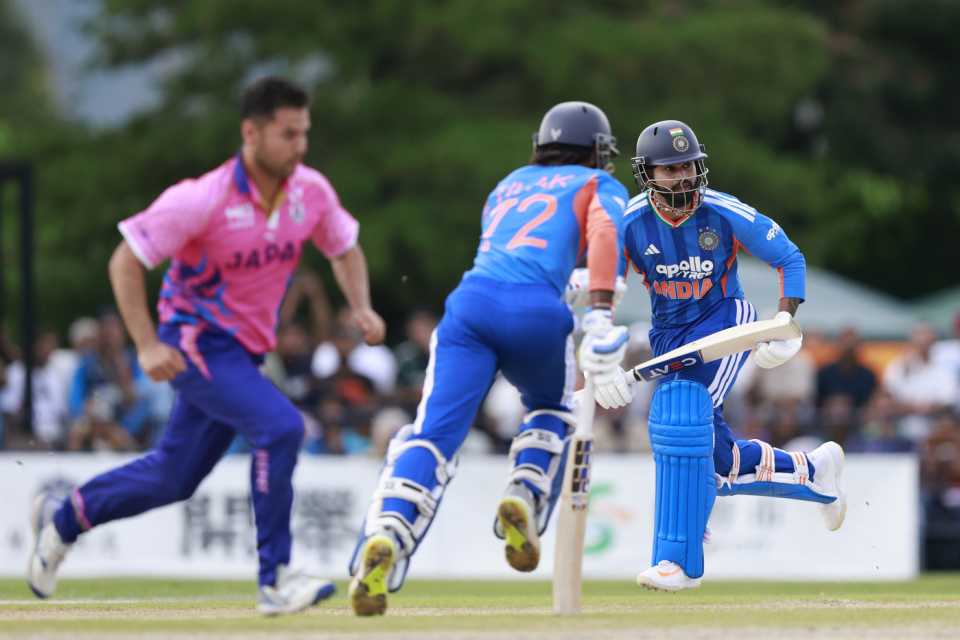
India defended just 32 to edge Japan by two runs in a dramatic five-over T20I encounter.
India survived one of the most extraordinary contests of their recent campaign, defeating Japan by just two runs in a rain-affected five-over T20I in Sano.
After India were restricted to only 32 runs, Japan came agonisingly close to completing a remarkable upset. However, Axar Patel held his nerve in a tense final over to ensure India defended the lowest total ever successfully defended in a five-over T20I.
Japan’s spinners dominate
Heavy rain across the previous two days delayed the start, with conditions making batting extremely difficult.
Once play finally began, India opted to bat after Shreyas Iyer won the toss.
Abhishek Sharma fell to the first ball he faced, attempting to play a shovel-sweep, leaving India immediately under pressure.
The pitch offered considerable turn and was extremely slow, making strokeplay difficult. All 10 overs of the match were bowled by spinners, while only four boundaries were scored throughout the entire contest.
Iyer adjusted his approach and anchored India’s innings, scoring 16 from 12 balls as wickets continued to fall around him.
India eventually managed just 32 runs, leaving Japan requiring 33 from their allotted five overs.
Axar Patel turns the match
Axar Patel immediately demonstrated why he would be crucial to India’s defence.
He conceded only two runs from the opening over, while Ishan Kishan’s direct hit from deep square leg resulted in the run-out of Lachlan Yamamoto-Lake.
Japan were reduced to 8 for 2 after two overs, but they refused to surrender.
They responded with 10 runs from Ravi Bishnoi’s over and seven from Washington Sundar’s, leaving them requiring only eight runs from the final over.
Axar returned for the decisive over with the match finely balanced.
Dramatic final over
The final over produced further tension when leg-side wides were called against Japan batter Alexander Shirai-Patmore.
One call reduced Japan’s requirement to five runs from four balls, creating visible frustration in the Indian camp.
New Zealand umpire Chris Brown then intervened and overturned the second wide call made by square-leg umpire Chris Thurgate.
Despite the confusion, Axar remained composed.
His accuracy on a difficult, turning surface prevented Japan from finding the boundary they needed, and India eventually secured a two-run victory.
Japan finished just short of what would have been one of the most memorable upsets in Asian cricket.
The result also highlighted the unusual nature of the contest, with India’s 32 becoming the smallest total successfully defended in a five-over T20I.
For India, it was a narrow escape; for Japan, a remarkable performance that came within two runs of producing a historic result.